| |
 |
| |
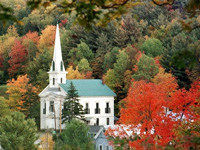
First
Congregational Church in South Woodbury, Vermont. Viele solcher
Kirchen, von denen manche noch aus dem 17, Jahrhundert stammen,
findet man in Neu England.
(© AP Images) |
Schon
früh in ihrer Geschichte lehnten Amerikaner das Prinzip der Staatsreligion
ab, das so viele europäische Länder beherrscht und entzweit
hatte. Die Trennung von Kirche und Staat wurde durch den ersten Verfassungszusatz
geregelt, der besagt: "Der Kongress darf kein Gesetz erlassen,
das die Einführung einer Staatsreligion zum Gegenstand hat oder
die freie Religionsausübung verbietet."
Eine
der ersten festen Siedlungen auf dem Gebiet der späteren nordamerikanischen
Kolonien wurde von englischen Puritanern gegründet, Calvinisten,
die in ihrem Heimatland Aussenseiter waren, wo die Anglikanische Staatskirche
vorherrschte. Somit waren Protestanten die am weitesten verbreitete
Religion in den frühen Jahren. Heute ist Amerika eine der Gesellschaften
mit der grössten Religionsvielfalt in der Welt.
Im Jahr 2005 zählten die Protestanten mehr als 100 Millionen Gläubige,
die Katholiken 67 Millionen und Juden 6 Millionen. Der Islam hatte ebenfalls
6 Millionen Anhänger, viele von ihnen sind zum Islam übergetretene
Afro-Amerikaner. Es wird geschätzt dass sich die Anzahl der Moscheen
in den USA, heute etwa 2000, in den letzten 15 Jahren verdoppelt hat.
Auch Buddhismus und Hinduismus wachsen mit der Anzahl der Einwanderer
aus Ländern, in denen dies die Hauptreligionen sind.
Amerika
war auch immer ein fruchtbarer Nährboden für neue Religionen.
Die Mormonen und die Christliche Wissenschaftskirche sind vielleicht
die am besten bekannten Glaubengemeinschaften, die auf amerikanischem
Boden entstanden sind. Wegen ihrer Tradition der Nichteinmischung in
religiöse Angelegenheiten boten die USA auch eine Zuflucht für
viele kleinere Glaubensgemeinschaften aus Übersee. So zum zum Beispiel
für die Amischen, Nachfahren von deutschen Einwanderern, die sich
hauptsächlich in Pennsylvania und den angrenzenden Bundesstaaten
niedergelassen haben, und seit Generationen dort das einfache Leben
ohne moderne Technologie praktizieren. Einige Glaubensgemeinschaften
werden auch als "Cults" (Sekten oder Kultreligionen) bezeichnet,
wenn sie für extreme Überzeugungen eintreten und eine Gründerfigur
verehren. Solange sich Sekten und ihre Mitglieder an die Gesetze halten,
werden sie in Ruhe gelassen. Religiösbedingte Diskriminierung ist
in Amerika eher selten und interkonfessionelle Gespräche und Zusammenarbeit
sind an der Tagesordnung.
Siehe auch:
About the USA > Amerikanische Feiertage
> Ethnische und Religiöse Feiertage |
|
Protecting
Religious Freedom without Limiting Free Speech
(America.gov,
December 30, 2009)
Being
Muslim in America illustrates in word and image that practicing
the Muslim faith is fully compatible with being American, and that Muslim
Americans are endowed by right with the same freedoms, privileges, and
responsibilities as other Americans.
(America.gov, March 2009)
 Freedom
of Faith. eJournal, August 2008 Freedom
of Faith. eJournal, August 2008
The principle of religious freedom is a cherished right in the United
States, one that has historical roots older than the formation of the
nation itself. In the 21st century, the United States pulses with a
unique cultural chemistry brought on by a wave of immigration which
has brought followers of more diverse faiths to many communities. This
edition of eJournal USA examines how the nation adjusts to these demographic
changes to remain true to the principles of freedom of faith.
One New York City Neighborhood Is a World of Religious Diversity
By Carrie Lowenthal. America.gov, August 1, 2008.
The street blocks in Flushing, New York, may seem long
to walk on a hot summer day, but they make the distance between the
world's many religions seem short. There are over 200 places of worship
in Flushing, and many festivals like the annual Ganesh Chaturthi parade...
Amish
Free to Maintain Religious Traditions in Modern World
Driving through Lancaster County, Pennsylvania, a traveler might find
a line of cars creeping along the pastoral countryside. Somewhere ahead,
an ambling, horse-drawn wagon likely carries members of the steadfast
Amish community rooted there... (America.gov, August 1, 2008.)
U.S.
Megachurches Thrive in Climate of Faith, Tolerance, Bigness.
By Ralph Dannheisser. America.gov, August 1, 2008.
The United States is fertile ground for questing, experimental religious
congregations. In recent decades, one of the most striking trends has
been the emergence of so-called megachurches that serve the needs of
an increasingly suburban culture. These new-style churches offer their
members a broad range of religious and social services. They also provide
a sense of community and fellowship -- not to mention parking, child
care and, often, some high-tech entertainment...
Survey
Finds Americans Are Religious, Tolerant, Nondogmatic.
The typical American believes in God (92 percent), believes in absolute
standards of right and wrong (78 percent), prays at least weekly (75
percent), believes in life after death (74 percent) and believes in
sacred scripture as the word of God (63 percent). But that typical American
is also tolerant of other peoples' beliefs and strikingly nondogmatic
in the sense of not believing his or her own religion to be the only
path to salvation or to have a monopoly on truth. These findings emerge
from a new study by
the Pew Forum on Religion and Public Life... (America.gov, June
27, 2008.)
The
Roots of Religious Liberty
Religious freedom is one of the most prized liberties of the American
people, a fact that strikes some people as incongruous if they think
of the United States as a secular society. That very phrase, however,
is misleading, in that it implies a society in which religion and religious
ideals are absent, and secular values alone govern daily conduct. Religion
is not absent from daily life in the United States; rather, the Constitution
has created a system in which each individual and religious group can
enjoy the full freedom to worship, free not only from the rein of government
but from pressures by other sects as well..... (Rights of the People:
Individual Freedom and the Bill of Rights. America.gov, June 22, 2008)
Main
Religious Affiliations in the United States.
Almost all the world's religions are practiced today in the United States.
The American tradition of religious tolerance and constitutional safeguards
for freedom of worship has made religious life in the United States
one of most diverse and vibrant in the world. (America.gov, March
19, 2008.)
U.S.
Religious Landscape Is Marked by Diversity and Change.
By Melody Merin.
Religious affiliation among U.S. residents best can be described as
'diverse and extremely fluid,' according to a new poll conducted by
the Pew Forum on Religion and
Public Life. (America.gov,
March 17, 2008.)
Religion
in the Workplace Is Diversity Issue for U.S. Companies.
By Louise Fenner
American companies are looking for ways to deal with a diversity issue
they increasingly face: the need to accommodate workers' various religious
beliefs and practices. (America.gov, November 28, 2007.)
|


 U.S.
Diplomatic Mission to Germany /Public
Affairs/ Information Resource Centers
U.S.
Diplomatic Mission to Germany /Public
Affairs/ Information Resource Centers